Why Your AI Output Sounds Right but Isn't
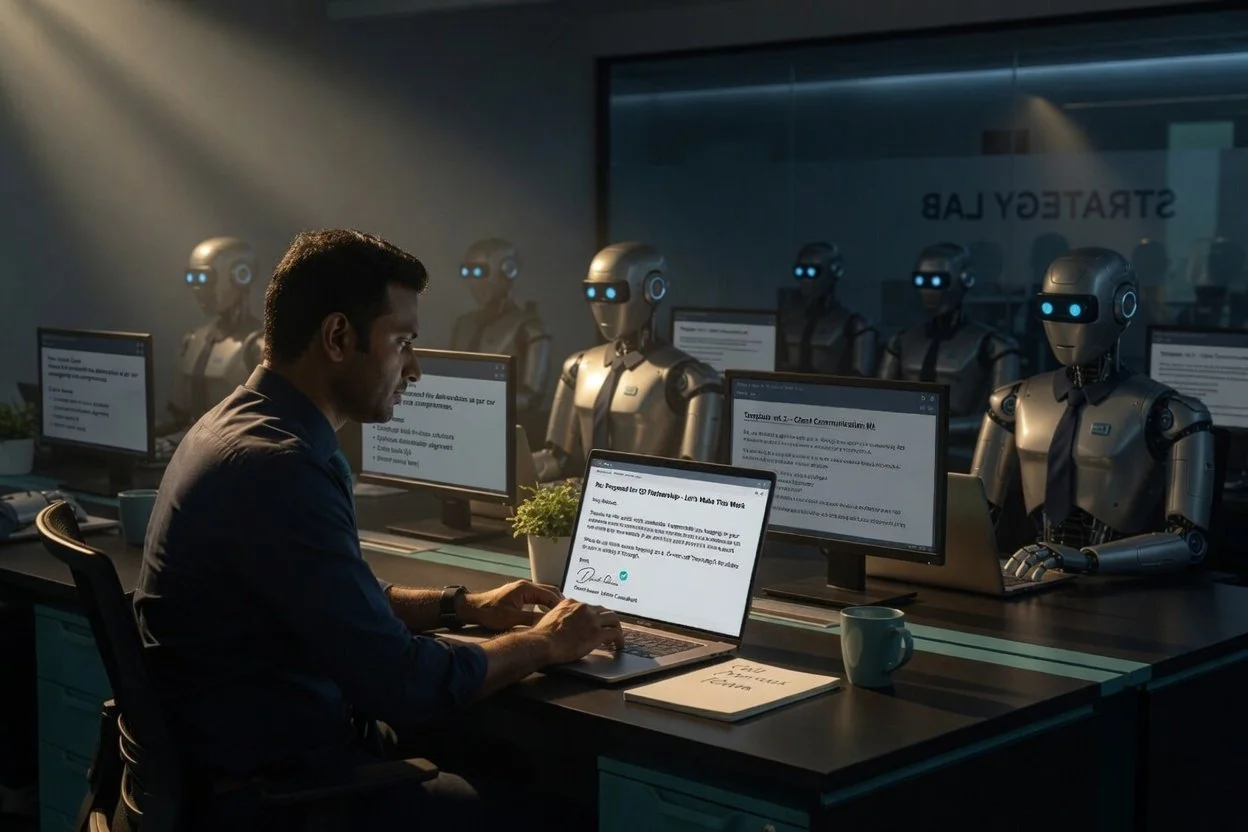
Most professionals who have been using AI for a few months hit the same wall. The novelty has worn off. They've stopped being impressed that it can write something and started being frustrated that it keeps writing the wrong something. The outputs are coherent but generic. Technically fine, practically useless.
The instinct at that point is to assume the tool has a ceiling. It usually doesn't. The ceiling is the prompt.
Writing a clear prompt and writing a clear document are the same cognitive act. Both require you to know your audience, specify your purpose, and anticipate what the reader—human or AI—needs in order to do something useful with what you've given them. Most people were never taught to do this explicitly for documents, and they haven't learned to do it for prompts either. The habits transfer. They just have to be built first.
Here's what that looks like across three scenarios where the gap between weak and strong is especially costly.
The Client Summary Email
Weak: "Summarize this project status report for a client. Keep it professional and under 200 words."
Not bad for a first attempt. There's a format constraint and a tone note. But AI still doesn't know who the client is, what they care about, or what the summary is supposed to accomplish. Professional to whom? Under 200 words structured how? It will produce something polished and generic—written for a hypothetical client rather than an actual one.
Strong: "Act as a senior account manager at a professional services firm. My client is the operations director at a mid-sized manufacturing company. She is not technical and tends to skim long emails. Summarize the attached project status report in 3 short paragraphs. Focus on timeline and budget—skip the methodology section entirely. Do not use jargon. Do not use passive voice. Close with one clear next step."
The difference isn't length—it's specificity about audience and purpose. A writing teacher would call this rhetorical awareness. In prompting, it means the output arrives closer to finished because AI understood who it was writing for and why.
The Performance Note
Weak: "I'm a manager writing performance review prep notes for a billing coordinator. She's a strong performer but struggles with communication—emails are sometimes unclear and she doesn't always flag issues early enough. Write 3 bullet points I can use in her review."
This one is closer. There's a role, a job title, some behavioral detail. But "struggles with communication" and "sometimes unclear" are interpretations, not observations. AI will write bullets that sound specific but aren't grounded in anything real—which means a rewrite anyway. You handed AI your conclusions instead of your evidence, and it has nothing to work with but the conclusions.
Strong: "Act as a direct manager writing internal prep notes for a performance review—not the formal document, just notes to inform it. The employee is a billing coordinator who consistently meets deadlines and is well-liked by the team, but sends unclear emails that require follow-up and sometimes waits too long to flag problems. Write 3 short bullets: one specific strength, one specific growth area, one suggested development action. Be direct. Do not use HR buzzwords."
The second prompt has done the thinking the manager needed to do anyway. That's the actual function of writing a prompt well—it forces you to clarify what you know and what you need before AI enters the picture. The drafting gets easier because the thinking happened first.
The Internal Proposal
Weak: "Act as a business writer helping me draft an internal proposal to get approval for new scheduling software. We're a professional services firm and our current process is slow and causes errors. Make it persuasive."
There's a role assignment and some context, which is progress. But "slow and causes errors" isn't a business case—it's a complaint. And "make it persuasive" tells AI to push harder, not smarter. The output will have confident, forward-leaning language wrapped around a thin argument. It will sound like it's making a case without actually making one.
Strong: "Act as an operations manager making an internal business case to a skeptical CFO. We are a 40-person accounting firm. We currently schedule client appointments manually via email, which causes double-bookings and costs roughly 3 hours per week across the admin team. I'm proposing scheduling software at approximately $200/month. Write a one-page business case: current problem, proposed solution with cost, expected ROI. Plain prose, no bullet points. Acknowledge the cost upfront. Do not oversell—this CFO values directness over enthusiasm."
That last constraint—do not oversell—is where experienced prompt writers separate themselves. Constraints aren't just guardrails. They're how you encode your understanding of the reader into the prompt. The more specifically you can describe what the output should avoid, the closer the first draft lands. It's the same reason a good editor's comments are often more useful than a rewrite: knowing what to cut is harder than knowing what to add.
The Pattern Across A Three
When an AI output disappoints you, the problem is almost always one of four things: you didn't tell it who the audience is, you didn't give it enough situational context, your task wasn't specific enough, or you didn't constrain what it should avoid.
These are not prompting problems. They are writing problems. And they respond to the same fix: slow down before you type, think about who reads this and what they need, and put that thinking into the prompt.
The people on your team who write well already know how to do this. They just don't know they know it yet.
Howard Workshop Group helps professional teams build the prompting skills that turn AI from a novelty into a reliable part of daily work. If your team is getting inconsistent results, the fix is usually one workshop away.
This post was drafted and revised using Claude as a writing tool. The ideas, structure, and voice are mine—the AI handled the keystrokes. Image generated with Grok.